
Nika Casino UK Guide
Nika Casino Verification: KYC Documents, Checks and Review Time
 Available in GB
Nika Casino uses KYC and identity verification. Current official Terms state that verification can require a valid passport or another government-issued ID and proof of residential address, while the official FAQ also describes payment-card evidence when cards have been used on the account. The current Terms say a complete documentation package is typically reviewed within 10 days after it is received, but complex cases can take longer and may require additional steps. That wording is not a guaranteed 10-day completion promise. The Terms also list the UK as a Restricted Territory, so this page explains the operator’s verification rules rather than implying UK account eligibility. For Great Britain context, UK Gambling Commission licensees must verify customer identity before permitting gambling, but that regulatory benchmark does not establish that Nika is UKGC licensed or compliant.
- The document list supported by current official evidence
- When Nika can request verification
- What “typically within 10 days” actually means
- Card verification: expose less, not more
- Identity verification and Great Britain regulation
- How to reduce avoidable verification delays
- What a strong KYC request should clarify
- Frequently asked questions
- Bottom line
The document list supported by current official evidence
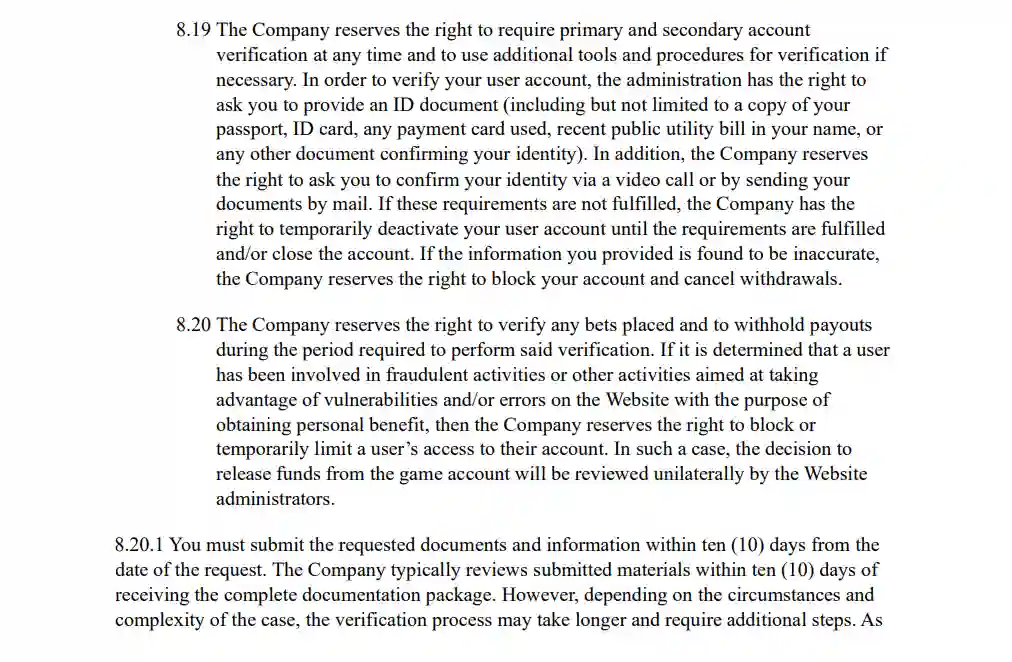
The safest way to describe Nika verification is to stay with the operator’s own current documents. The KYC section of the Terms identifies a valid passport, another government-issued identity document and proof of residential address. Elsewhere in the current Terms, account verification can include an ID document, a payment card used on the account and a recent utility bill in the user’s name. The published requirements therefore support identity and address checks without implying that every customer will be asked for the same documents in every case.
The official FAQ adds specific instructions for payment cards used on the account. It says the submitted card image should leave the first six and last four digits visible. The Terms say the remaining card-number digits and the CVV/CVC security code should not be visible. This is an important practical detail because a verification request is not a reason to expose the full card number or card security code.
The FAQ also refers to the photo page of a passport. Where a casino or payment review requests documentary evidence, use the instructions presented in the current official verification surface rather than sending extra documents that have not been requested.
When Nika can request verification
Nika’s Terms describe verification as an account-control process rather than a one-time signup checkbox. They allow the operator to conduct identity and contact checks and to request supporting documentation. An account can be suspended while requested information is outstanding. This is why registration and KYC should be treated as separate stages.
The parent Nika account covers email confirmation, login recovery and one-account rules. KYC begins when the operator checks that profile information and identity evidence match. Depending on the case, the Terms also allow additional verification steps.
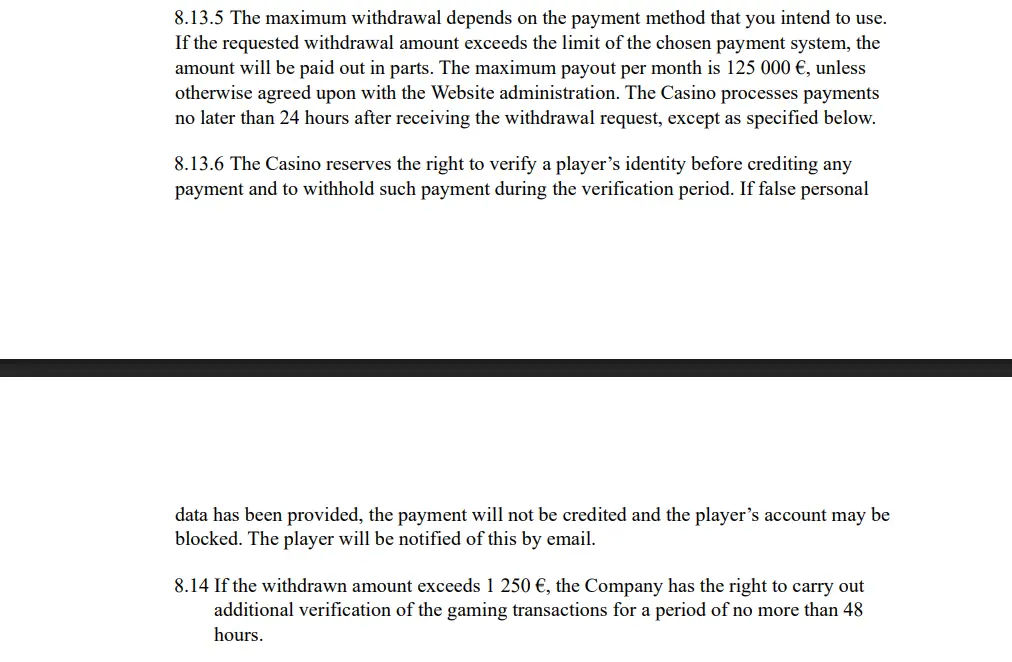
Verification can intersect with withdrawals. The current Terms state that a requested withdrawal of €1,250 or more can require an identification procedure, while a separate clause says a withdrawn amount exceeding €1,250 can trigger additional gaming-transaction verification for up to 48 hours. Those checks are not the same as the general KYC review timetable and should not be combined into a single “withdrawal time” number. The dedicated withdrawal guide separates those clocks.
What “typically within 10 days” actually means
The current Terms contain direct timing language for submitted KYC materials. They say requested documents and information must be submitted within 10 days of the request and that the company typically reviews submitted materials within 10 days after receiving the complete documentation package. The same clause immediately says the verification process can take longer depending on the circumstances and complexity of the case and can require additional steps.
That wording supports a precise but qualified statement: a complete package is typically reviewed within 10 days. It does not support “KYC always takes 10 days”, “verification is guaranteed in 10 days” or “withdrawals arrive within 10 days”. Review time and payout delivery are different facts.
The phrase “complete documentation package” also matters. The review period described by the Terms starts after the complete package is received, not necessarily when the user first opens a verification request or uploads one file. If additional information is requested, the overall process can extend beyond the typical period stated in the Terms.
Card verification: expose less, not more
The current official FAQ and Terms support a clear masking rule for a payment card used on the account. The first six and last four digits can remain visible for identification, while the intervening card-number digits and CVV/CVC security code should be hidden. The FAQ also says the cardholder’s name and expiry information should be visible in the submitted card image.
Those details are more useful than the generic instruction to “upload your card” because they tell the reader which information should not be exposed. They also show why the operator’s current written instructions should take priority over third-party illustrations or summaries, which can get the masking rule wrong.
This site never needs a user’s documents, card image, passport, account password or verification code. KYC materials belong only in the operator’s official verification channel when legitimately requested.
Identity verification and Great Britain regulation
For Great Britain, the UK Gambling Commission’s current Licence Condition 17.1.1 requires covered remote licensees to obtain and verify information establishing a customer’s identity before that customer is permitted to gamble. The minimum information includes name, address and date of birth. The Commission also says a withdrawal request should not become the point at which a licensee asks for additional information that could reasonably have been requested earlier.
That is useful regulatory context for a UK-focused reader, but it must not be misapplied to Nika. The rule describes obligations of UKGC remote licensees. It does not prove that Nika holds a UKGC licence, and this page does not claim that Nika follows UKGC KYC requirements. The separate licence and UKGC context page handles regulator scope and local-licence verification.
There is also a basic GEO boundary: Nika’s current public Terms explicitly include the UK among Restricted Territories. A KYC process existing on the site does not establish that UK residents are accepted. Verification capability and geographic eligibility are different facts.
How to reduce avoidable verification delays
- Keep account information accurate and consistent with the identity document used for verification.
- Use only the official Nika verification or support route shown on the official domain.
- Submit the document types actually requested rather than adding unrelated personal material.
- For payment-card evidence, follow the current masking instructions and never expose the CVV/CVC code.
- Remember that the 10-day wording is a typical review period after a complete package is received, not a guaranteed deadline.
- Do not confuse additional gaming-transaction verification above €1,250 with the general KYC review period.
What a strong KYC request should clarify
A useful verification request should make clear which document is needed, why it is being requested and how it should be supplied through the official account channel. Nika’s current Terms allow additional documentation and additional verification steps, so the exact request can depend on the case. That makes it important to follow the live instructions attached to the account rather than relying on a copied checklist from an old review.
For address evidence, the current official Terms support proof of residential address and also refer to a recent utility bill in the user’s name in the broader verification clause. For identity, they support a passport or another government-issued ID. For a card used on the account, the official masking instructions are the practical control: enough digits remain visible to identify the card, while the rest of the number and the CVV/CVC are hidden.
There is also an important distinction between the operator that requests verification and an independent information website. This site does not receive, process or store player KYC documents. Readers should not send passports, card photos, bank statements, passwords or one-time codes to an editorial website or to an unknown contact discovered through search. Use only the verified operator channel when a legitimate account requires verification.
Frequently asked questions
Does Nika Casino require KYC?
Yes. Current official Terms describe KYC and identity verification and allow the operator to request supporting identity and address documentation.
Which identity documents are directly supported by the current official sources?
The current Terms identify a valid passport or another government-issued ID and proof of residential address. The FAQ also describes payment-card evidence when cards were used on the account.
How long does Nika KYC take?
The current Terms say complete document packages are typically reviewed within 10 days after receipt, while complex cases can take longer and require additional steps. It is not a guaranteed SLA.
Should the full card number and CVV be visible in a verification image?
No. Current official instructions support showing the first six and last four digits while hiding the intervening digits and the CVV/CVC security code.
Does Nika KYC prove the casino is UKGC licensed?
No. KYC capability and UKGC licensing are separate facts. UKGC identity rules apply to its licensees and do not by themselves establish Nika’s local licence status.
Bottom line
Nika’s current official evidence supports a specific KYC picture: identity can be checked with a passport or other government-issued ID plus address evidence, and payment-card verification can be requested when cards were used. Card evidence should follow the operator’s masking instructions rather than exposing the full card number or CVV/CVC. The Terms say a complete documentation package is typically reviewed within 10 days, while complex cases can take longer. That is a qualified review-time statement, not a guaranteed payout or verification deadline.
For the broader brand and UK restriction context, return to the Nika Casino review.
Prepared by the Nika Casino editorial staff.